
Reliance Jio submitted the highest pre-auction deposit.
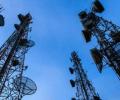
Successful bidders will have to pay 25 per cent of the amount upfront for sub 1 GHz, and 50 per cent upfront for higher frequency bands.

Credit Suisse said if the deal fructifies, then this will bring together the largest offline and online retailers in India.

Cross previous high of $72 billion in 2007 as Indian promoters overcome the selling taboo. Abhineet Kumar reports from Mumbai.

Experts say going ahead data price will fall further due to competition

The deal includes Reliance Infrastructure's integrated business of Generation, Transmission and Retail Electricity Distribution

Despite the recent fall, the Nifty Midcap 100 index has outperformed by gaining 20 per cent till date in this year calendar year.
Despite the recent fall, the Nifty Midcap 100 index has outperformed by gaining 20 per cent till date in this year calendar year.

We asked colleagues, present and past, to reflect on a man who has made such a difference to their lives and careers. Here it is then, a rich collection of memories that offer enchanting glimpses of the enigmatic Ajit Balakrishnan.

Kapoor and his associate entities owned 10.6 per cent in the bank at the end of June 2019.

The Telecom Regulatory Authority of India (Trai) has given its recommendations on the much-awaited issue of spectrum sharing.

Pointing out to the 133-acre Dhirubhai Ambani Knowledge City on the outskirts of the financial capital, he said there is huge realty play opportunity that RCom's erstwhile corporate headquarters possesses, and pegged the potential value creation at the site at Rs 25,000 crore.

Funds will be raised via non-cumulative preference shares issued to Tata Sons on rights basis

The one common theme across companies that have rewarded shareholders is consumption.

Adani Enterprises' proposed Rs 20,000 crore (Rs 200 billion) fundraising via fresh issue of equity shares through a public offer would be the fourth biggest by Indian companies, excluding banks and non-banking financial companies.

US and European institutional investors bought a majority of shares in the over Rs 4,800 crore (Rs 48 billion) QIP offering by telecom operator Reliance Communications.

'We will likely never know why Xi decided not to travel to New Delhi. One possible explanation could be his desire to avoid a meeting with US President Joe Biden.'

Dixon Technologies right now is a beehive of activity. It is building a new facility in Noida to make 1.3 million laptops for Taiwanese PC maker Acer. The facility must be up and running in four months. The pace of activity will only increase. Last week Dixon won a similar contract from Lenovo, the Chinese personal computer maker and the third largest information technology (IT) hardware brand in India, to assemble laptops and notebooks. Though the clientele in these two cases is Taiwanese and Chinese, Dixon is a company reaching for the stars with its feet planted firmly in the Indian government's policy.

Quite a few large- and mid-cap stocks are yet to recover from the note ban, pharma, banking and rural demand-based industries among laggards.

Evolving a common work ethic and culture will be critical so that the merged entity does not lose focus on the common enemy outside -- and instead becomes more obsessed with internal turf wars.

Private equity investments into domestic companies fell sharply year-on-year by 42 per cent to $23.3 billion in 2022, which is the lowest since 2019, when it was $15.8 billion, according to an industry report. The numbers reflect the overall funding winter that the startup space in particular, and the overall foreign investments in general have been witnessing since the Ukraine war began last February. Private equity investment inflows into the country fell by a sharp 42 per cent in 2022 from last year to $23.3 billion -- the lowest annual inflows since 2019 when it was a low $15.8 billion, but still relatively elevated compared to historical levels, said Elaine Tan, a senior analyst at Refinitiv, the LSEG business arm that provides financial markets data and insights.

Most of the session's gains for both the indices were wiped out as investors rushed to book profits ahead of F&O expiry on Thursday and also due to concerns over stretched valuations.
A sluggish economy and stalled bureaucratic decision-making for the past two years thwarted capital investment and dented earnings, making it tough for the companies to raise funds.

In a setback to telecom service providers, the Supreme Court on Thursday allowed the Centre's plea to recover adjusted gross revenue (AGR) of about Rs 92,000 crore from them.

Analysts said with more power sector companies referred to the NCLT by banks, large companies would be at an advantage.

The intra-city cable leasing deal will give RCom Rs 1,200 crore, which will be used to clear some of its debt.

After a turnaround in performance by Indian equity markets since July that has seen the S&P BSE Sensex and the Nifty50 wipe out the year-to-date losses, analysts suggest investors start nibbling into stocks that are focused on the domestic economy. While they say intermittent corrections, led by policies of global central banks and other economic data, cannot be ruled out, analysts expect India's relative outperformance among global equity markets to continue as it looks better placed with a healthy economic recovery, and remains one of the fastest growing major economies. In this backdrop, Neeraj Chadawar, head of quantitative equity strategy at Axis Securities, believes that amid global slowdown, aggressive tightening by the central banks, and preference for domestic interests first (by the local government), export-oriented themes are likely to be muted or will deliver conservative returns in the near-term.

More than 10% (40 of 498 companies) have lost at least half their market value.

The 30-share Sensex ended up 1 point at 27,459 and the 50-share Nifty ended down 1 point at 8,341.

Both the indices ended at their highest levels since February 1.
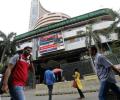
Sensex rises, Nifty holds 8,900; FMCG, Pharma shares lead.

Telecom shares rallied on hopes that they would hike tariffs after huge investments to acquire spectrum.

Eight Sensex biggies such as Reliance, L&T, BHEL, SBI and ICICI Bank are among the worst hit.

Jio's disruptive strategy, including free voice services and data at throwaway rates, apart from offering all services free for six months, triggered a consolidation in the telecom sector.

Fresh buying by domestic institutional investors and better-than-expected June quarter results from some blue-chip companies boosted investor sentiment

Wipro, Steel Authority of India, HDFC Bank, Mahanagar Telephone Nigam, Bharat Heavy Electricals and Reliance Commnications among companies reporting a decline in headcount in FY17.

Govt's revenue estimates may take hit on spectrum sharing, trading deals

The Big Two telecom companies have accelerated their moves towards this next-gen technology, though they have chosen very different routes to getting there.
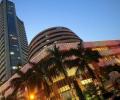
The 30-share Sensex ended up 8 points at 27,508 and the 50-share Nifty closed 1 point higher at 8,284.

On the method of computation of its share value under the new dispensation for the purpose of taxation.
 © 2026 Rediff.com - Advertise with us - Disclaimer - Privacy Policy - Sitemap - Feedback - About us - Terms of use - Grievances